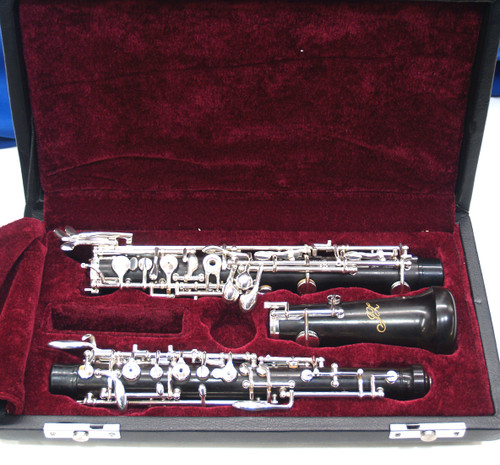


Advanced / Professional C Oboe
Composed wood body
Full conservatory- A full conservatory system on an oboe means the instrument features a complete set of professional keywork rather than a simplified or student-level mechanism. A full conservatory oboe ensures that advanced repertoire is never restricted by missing keys.
Standard components include:
Low Bb with a vent key
Left-hand F lever
Articulated C# mechanism
Full ring system D key
Triple octave arrangement (semi-automatic, US standard)
Advanced trill mechanisms (such as D-C and left-hand G#-A trills, split ring Eb-E, or Ab-Bb mechanisms)
Semi-auto keys that are silver plated - Semi-automatic keys on an oboe refer to the octave key mechanism where the first and second octave vents are connected so that pressing the second octave key automatically closes the first
Includes French case & bag
A "C oboe" is the standard, most common type of oboe used in orchestras and bands worldwide
Concert Pitch Instrument: It is a non-transposing instrument. This means when an oboist reads a "C" on their sheet music and plays it, the actual sound produced is a concert C.
The Double Reed: Like all oboes, it creates its distinct, piercing sound using a double reed (two pieces of cane tied to a metal tube) that vibrates when air is blown through it.
The Soprano Voice: It serves as the soprano (highest-pitched standard voice) of the oboe family, with a musical range spanning roughly 2.5 octaves.
Why is it specifically called a "C" Oboe?The "C" designation is used to differentiate it from other, lower-pitched relatives within the same instrument family
How the Semi-Automatic System Works
Two separate touch-pieces: The player uses a thumb key (for the first octave/low second-octave notes) and a side/second octave key (for high register notes) operated by the left hand.
The linkage: When you press the second (side) octave key, the mechanism automatically forces the first octave key vent to close.
The contrast: On a fully automatic oboe, a single thumb key controls both vents dynamically via a more complex opposing-lever system. On a non-automatic or traditional system, you have to manage the vents completely independently without automatic closing action